-spacing.png?width=385&height=100&name=mediavine-horiz-white-pn-RGB-(r)-spacing.png)
We have introduced a new set of monetizable metrics to give you a clearer, more accurate view of how your site generates advertising revenue.
These metrics are designed to complement your existing reporting, not replace it, so you can better understand both site growth and monetization performance.
What’s New in Your Dashboard
Your dashboard now includes:
- Monetized RPM (mRPM)
- Monetizable Sessions
- Monetizable Pageviews
You can view these metrics with more detail across various dashboard sections:
- Topline metrics
- Key Metrics
- Top Pages
- Top Countries
- Devices (by revenue)
- Traffic source
These metrics focus specifically on traffic where ads were able to serve, helping you understand how your inventory actually performs from a revenue standpoint at both a high level and a more granular level.
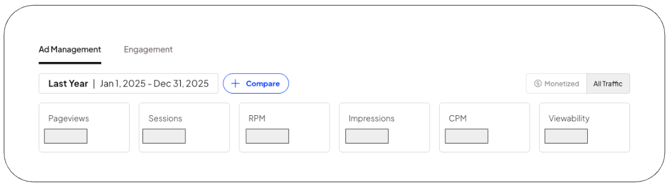
Your existing metrics, such as RPM, Sessions, and Pageviews based on all traffic, will remain available as the default view, and you can toggle between both sets of metrics at any time. Historical monetizable data is backfilled to January 1, 2025.
Why Monetizable Metrics Matter
Traditional metrics such as standard RPM include all traffic in their calculations even when that traffic could never generate advertising revenue.
This includes:
- Traffic from regions with low or no advertiser demand
- Invalid or non-human traffic, including AI bot crawlers
- Privacy consent restrictions
- Content category restrictions implemented on the advertiser side
- Ad blockers
While these sessions are a normal part of running a site, they can dilute your monetization metrics and make performance appear lower than it actually is.
Monetizable metrics solve this by isolating only advertising revenue-eligible traffic so you can better understand true monetization performance, not just a blended view across all sessions.
Growth Metrics vs. Revenue Metrics: Know The Difference
Think of your metrics in two complementary ways:
- All traffic metrics show how your site is growing, including audience reach and engagement.
- Monetizable metrics show how your advertising is performing, including advertising revenue efficiency.
Using both sets of metrics together gives you the most complete picture of your business.
Why Your RPM May Look Different
When viewing monetizable metrics, you may notice that mRPM is higher than your traditional RPM.
This is expected because the difference comes from removing sessions that were never eligible to generate advertising revenue. Instead of dividing revenue across all sessions, mRPM reflects only those that were eligible for ads to serve.
It’s important to keep in mind that this does not mean your revenue has increased or decreased; it means your measurement is more precise.
How to Use Monetizable Metrics
Monetizable metrics unlock more informed and strategic decision-making across your business.
1. Content Strategy
Not all traffic contributes equally to revenue.
- Identify pages with high mRPM and strong monetizable session volume
- Prioritize and expand content that drives both traffic and earnings
- Reevaluate pages with high traffic but low monetization impact
2. Traffic Acquisition
Understand which channels truly drive value:
- Some sources may generate high sessions but low monetizable traffic
- Focus on channels that consistently bring monetizable users, not just volume
3. Geographic Strategy Using Country-Level Metrics
Country-level monetizable metrics help you understand where your most valuable audiences are coming from.
- Identify countries with high mRPM and strong monetizable session share
- Prioritize content topics and SEO strategies that resonate in high-value regions
- Evaluate whether growth in lower monetizing regions is impacting overall performance
- Adjust partnerships and/or traffic investments based on revenue contribution, not just traffic volume
This allows you to move beyond global averages and make region-specific decisions that improve overall revenue efficiency.
4. Device Strategy Using Device-Level Metrics
Device-level monetizable metrics help you understand how user experience and monetization vary across platforms.
- Compare mRPM across desktop and mobile devices
- Identify if monetization underperformance against a specific device type
- Optimize layout ad placements and page experience for higher value devices (with the help of your Account Manager/Support Specialist)
- Validate the impact of design or UX changes on monetization performance
For example, strong traffic growth on mobile with lower mRPM may indicate an opportunity to improve mobile ad strategy and/or user experience.
This level of detail helps you take more targeted and effective actions.
Diagnosing Performance Changes
Monetizable metrics provide critical context when performance shifts, especially when combined with country and device breakdowns.
- If RPM declines but mRPM remains stable, this likely indicates a traffic quality shift
- If declines are concentrated in specific countries or devices, you can isolate the source more quickly
- If both RPM and mRPM decline across segments, this may indicate a broader monetization issue
What You Can and Cannot Control
A portion of your traffic will always be unmonetizable and that is completely normal.
Factors like ad blockers, AI bots, and regional advertiser demand are largely outside your control and affect all publishers.
Rather than trying to eliminate this traffic, monetizable metrics help you understand its impact and separate it from performance signals so you can focus on what actually drives advertising revenue.
Granular views, such as country and device, further help you focus on the areas where optimization can have the greatest impact.
Putting It All Together
The most effective way to use these metrics is in combination:
- Use Sessions and Pageviews to measure growth
- Use Monetizable Sessions and mRPM to measure advertising revenue efficiency
- Use country and device breakdowns to identify where performance is strongest or needs improvement